
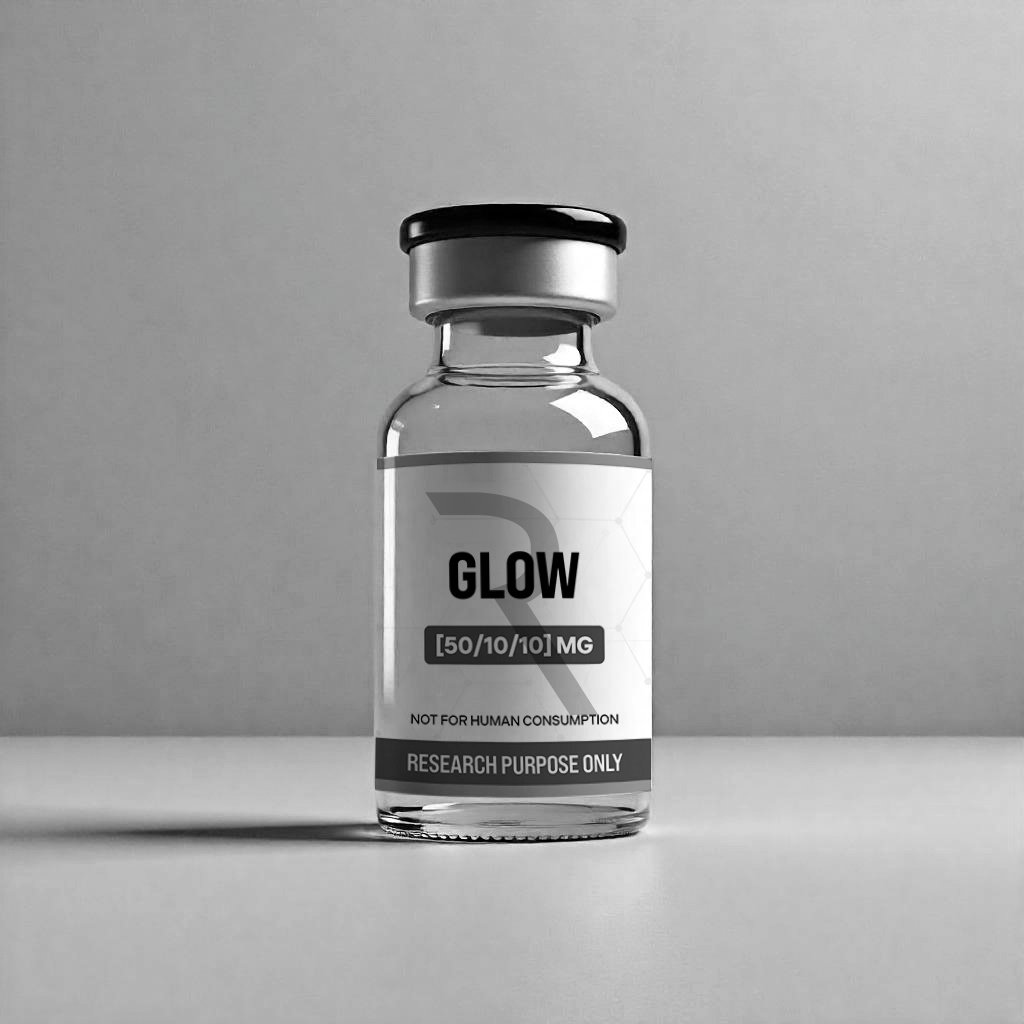


GLOW
$89.99
Free Shipping on orders over $200
Related products
GLOW Peptide Blend: Research Overview
This blend combines three distinct peptides with well-characterized research profiles:
- GHK-Cu (Copper Tripeptide): A naturally occurring copper-binding peptide involved in gene expression, tissue remodeling, and anti-inflammatory signaling
- BPC-157: A synthetic peptide fragment derived from body protection compound, studied for its influence on angiogenesis, cell migration, and cytokine activity
- TB-500 (Thymosin Beta-4 Fragment): A synthetic version of a naturally occurring actin-sequestering peptide, associated with cell migration, wound modeling, and vascular modulation
The specific ratio of this formulation (GHK-Cu 50%, BPC-157 5%, TB-500 10%) allows researchers to examine additive or synergistic effects across multiple biochemical pathways relevant to cell signaling and structural integrity.
1. GHK-Cu: Gene Expression and Tissue Remodeling
GHK-Cu has been shown to modulate the expression of hundreds of genes related to:
- Tissue repair, collagen synthesis, and extracellular matrix remodeling
- Anti-inflammatory signaling through inhibition of TNF-α and IL-6 expression [1]
- Copper ion delivery into cells, promoting antioxidant enzyme function and cellular respiration [2]
Studies have used gene array profiling and RNA sequencing to document the changes GHK-Cu induces in fibroblasts, keratinocytes, and endothelial cells.
2. BPC-157: Angiogenesis and Cytokine Modulation
BPC-157 is widely used in models studying angiogenesis and vascular repair:
- Promotes vascular endothelial growth factor (VEGF) expression and endothelial cell proliferation [3]
- Modulates cytokine levels, reducing IL-1β, IL-6, and TNF-α in inflamed tissue models
- Demonstrated ability to support tendon fibroblast migration in rat explant studies [4]
Its stability in gastric juice and plasma allows for extended study windows in gastrointestinal and musculoskeletal research models.
3. TB-500: Cell Migration and Actin Regulation
TB-500 (the synthetic form of Thymosin Beta-4) is studied for its ability to:
- Regulate actin polymerization, enhancing cell motility and wound closure [5]
- Promote angiogenesis through upregulation of VEGF and other pro-vascular signals
- Reduce oxidative stress and tissue fibrosis in preclinical cardiac and dermal models [6]
Researchers frequently use TB-500 to model tissue regeneration, particularly in cardiovascular, muscular, and epithelial contexts.
Synergistic Applications of the GLOW Blend
The combination of these three peptides in GLOW supports advanced studies in:
- Wound healing and epithelial regeneration
- Angiogenic and anti-inflammatory signaling
- Fibroblast migration and collagen matrix production
- Neurovascular remodeling and tissue oxygenation
Co-administration in this ratio enables researchers to evaluate multi-pathway peptide crosstalk and downstream transcriptional effects using in vitro and animal model systems.
Referenced Citations
- Pickart L, et al. “GHK-Cu stimulates wound healing and gene expression in skin fibroblasts.” Journal of Biomaterials Science, 2008. – PubMed
- Pickart L, et al. “Copper peptide GHK and tissue regeneration: gene expression profiling.” Molecular Genetics and Metabolism, 2012. – PubMed
- Sikiric P, et al. “BPC-157 and angiogenesis: novel peptide mechanisms.” Current Pharmaceutical Design, 2014. – PubMed
- Chang CH, et al. “BPC-157 enhances fibroblast migration and tendon healing in rats.” Journal of Orthopaedic Research, 2011. – PubMed
- Goldstein AL, et al. “Thymosin beta-4 promotes tissue regeneration by actin modulation.” Annals of the New York Academy of Sciences, 2007. – PubMed
- Smart N, et al. “Thymosin beta-4 and cardiac repair: angiogenesis and anti-fibrotic activity.” Nature, 2007. – PubMed
Product Usage:
This product is meant only for research use. It is made for lab testing and in vitro experiments (outside a living body), not for use in people or animals. All information on this website is for learning purposes only. Bodily introduction of any kind into humans or animals is strictly forbidden by law. It should only be used by trained professionals in a proper lab setting. This product is not a medicine, food, or cosmetic, and must not be sold or used as one.