
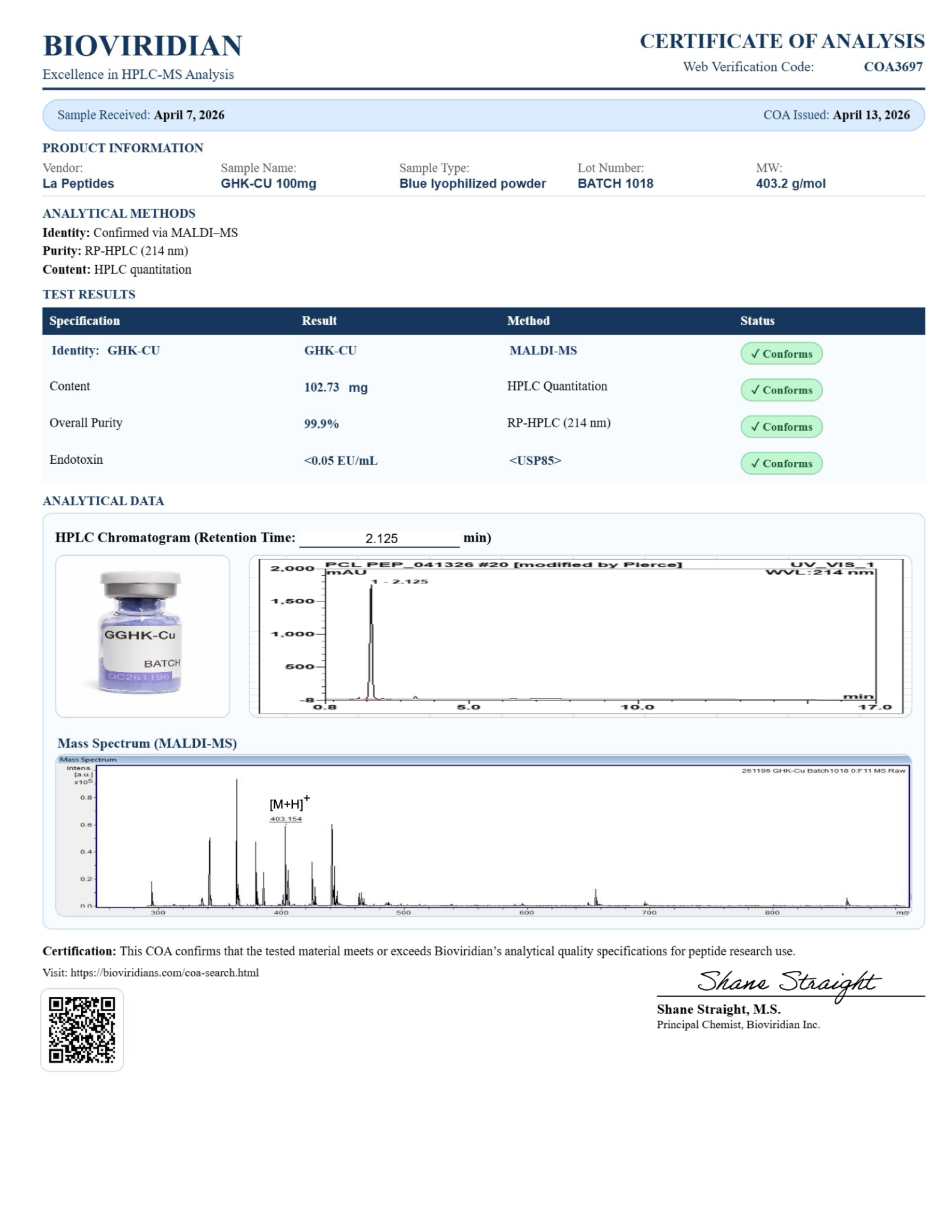
GHK-Cu
$39.99
Free Shipping on orders over $200
Related products
Research Overview
GHK is an endogenous tripeptide that forms a stable high-affinity complex with Cu(II), yielding GHK-Cu, a well-characterized ligand-metal pair.[1,2] In research settings, GHK-Cu serves as a model for copper delivery and signaling, enabling investigation of matrix protein synthesis, metalloproteinase regulation, antioxidant responses, and transcriptional reprogramming under standardized conditions.[3,4] Its versatility has made it a reference tool in dermatologic, regenerative, and oxidative stress research.
Molecular Structure & Copper Coordination
GHK (C₁₄H₂₄N₆O₄) coordinates Cu(II) through the histidine imidazole, terminal amine, and amide nitrogens to form a compact complex with defined geometry.[1] This allows precise analysis of binding constants, redox cycling, and competition with other copper ligands in biochemical systems.
Extracellular Matrix & Dermal Research
In skin- and fibroblast-derived models, GHK-Cu is used to assess effects on collagen, elastin, proteoglycans, and matrix metalloproteinases, as well as integrin and TGF-β associated pathways.[3] These experiments map gene and protein expression patterns associated with matrix maintenance and controlled remodeling.
Oxidative Stress & Gene Expression Studies
Studies utilizing GHK-Cu report modulation of antioxidant defenses, DNA repair-related transcripts, and cell viability under toxic or oxidative challenge.[4] These data are interpreted as mechanistic evidence for copper-peptide–dependent signaling, not as clinical outcomes.
Product Usage:
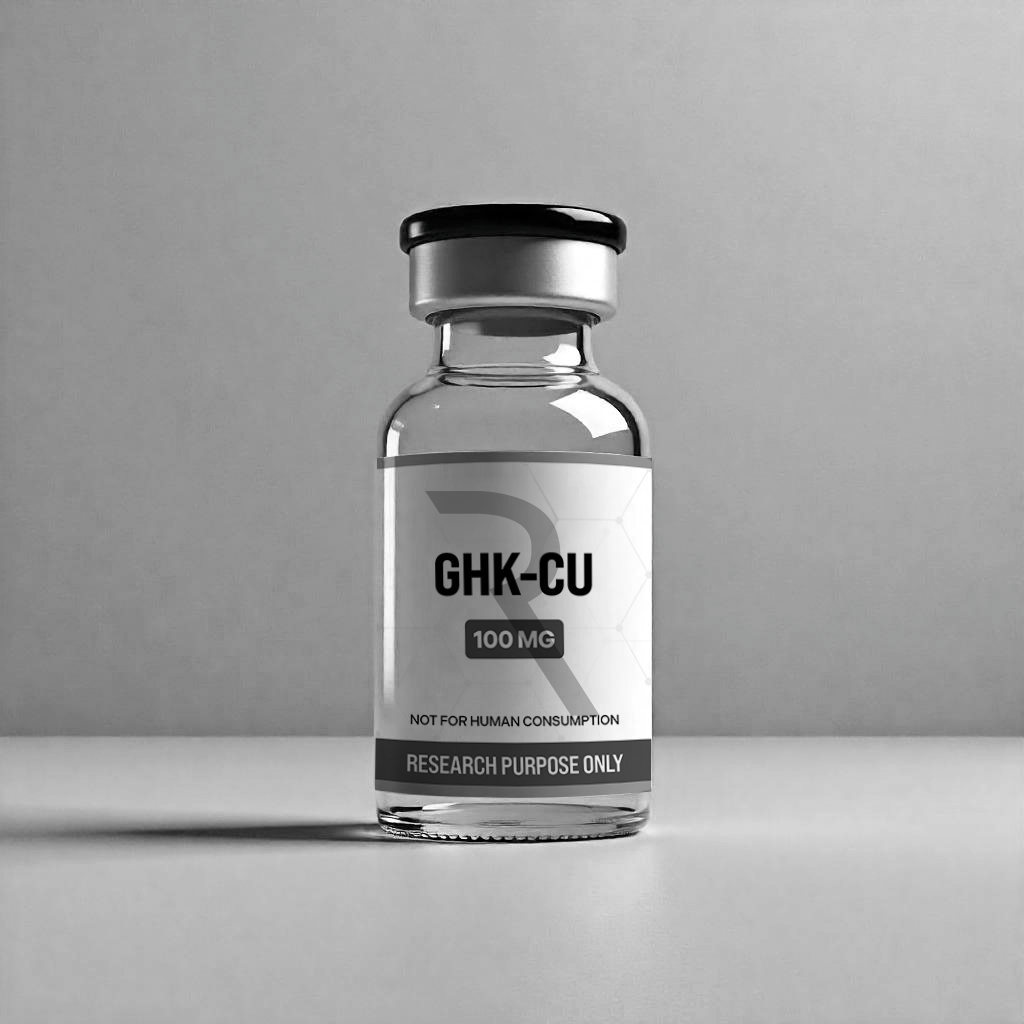
This product is meant only for research use. It is made for lab testing and in vitro experiments (outside a living body), not for use in people or animals. All information on this website is for learning purposes only. Bodily introduction of any kind into humans or animals is strictly forbidden by law. It should only be used by trained professionals in a proper lab setting. This product is not a medicine, food, or cosmetic, and must not be sold or used as one.